Kelowna Planning Staff don’t follow the rules January 23, 2026
I think the City of Kelowna Planning Department thinks it doesn’t have to follow the rules and Council doesn’t care. For example, the City Planning Department Staff recently approved a project in the Abbott Heritage Conservation Area (HCA) which according to both zoning and the Official Community Plan (OCP), was not allowed.
The HCA is zoned RU1 Large Lot Housing which includes specific housing types to meet the 4 units per lot mandated by the province. Recently, city Planning staff approved a stacked housing project stating that there were no variances to the zoning. A review of the Zoning Bylaw No.12375, indicated stacked townhouses did not fall into RU1 zone but in the MF-Multi- Dwelling zone.
What this indicates is that Planning staff did not follow the zoning regulations and approved a use that was not permitted. The act of not following the zoning regulations is a violation of Zoning Bylaw No. 12375 for which there are serious penalties under Section 3.4:
“Every person who violates a provision of this Bylaw commits an offence and is liable on summary conviction to a penalty not exceeding Fifty Thousand Dollars ($50,000.00) and the costs of prosecution. Each day a violation of the provisions of this Bylaw exists or is permitted to exist shall constitute a separate offence.”
Stacked townhouses are also discussed in the 2040 Official Community Plan (OCP). It states (Page 33):
“Stacked townhouses and low-rise apartments are supported adjacent to Transit Supportive Corridors.” The subject property is not. If not, Policy 5.3.3: Strategic Density states the property must be 1 hectare (2.47 acres) or larger. This property is not.
Therefore, the 2040 OCP also indicates that stacked townhouses are not permitted at this property.
A new complication entered the fray. At the last Kelowna council meeting of the year on Dec. 8, 2025, the Planning staff brought forward a list of 17 recommendations for miscellaneous changes to the zoning bylaw one of which was to include stacked townhouses in the RU1zone with no mention that they already permitted this and its inclusion should trigger a public hearing.
Staff weren’t disciplined and council, except Councillors Cannan, Hodge, and Lovegrove, approved inserting stacked townhouses in RU1 on January 12, 2026 knowing the facts. If the mayor and councillors can’t ensure city staff play within the rules, then what good are they? It is time for the mayor and most councillors to go.
Susan Ames
Why won’t the City of Kelowna support removal of the KGH Transit Oriented Area (TOA) from the Abbott Heritage Conservation Area (AHCA)? August 4, 2025
Despite information and logic the city of Kelowna says their hands are tied and it’s the BC Government’s fault that the bus stop in front of Kelowna General Hospital (KGH) is designated as a transit hub. With such a designation, comes a high density area (a TOA) which will allow six storey apartment buildings in the southern part of this little historical area which is, in total, less than 1/2 km2…a gem where it is estimated that over 20,000 residents and tourists come each year. The houses have their own heritage signs, there is a heritage walking brochure, there are streets without sidewalks, and numerous access points to Okanaganan Lake. The trees are large and cyclyists, walkers, runners, etc., come here for a reprieve from the concrete and traffic.
The BC provincial government said that floodplains are exempt from these high density TOA areas and the AHCA is located not on just one floodplain, but two, and yet the city is choosing to ignore this. Why?
Who identified the bus stop in front of KGH as a transit hub in the first place?
There are 7 bus stops along this route and KGH is just one of them and none of the other bus stops along the route are considered “transit exchanges”. The infrastructure is a bench and several stops have benches such as a stop at the Pandosy Village Centre, which is an area of numerous shops, restaurants, coffee shops, doctors offices, art galleries, medical labs, an elementary school, fast food restaurants, etc., and so if there is going to be any bus stop considered a transit “exchange”, this would be the place for it.
Pandosy Village Area.
KGH area
The province’s goal is to increase density around transit hubs such as around sky train stations, shopping centres, etc., where multiple bus routes terminate, as people wouldn’t need to get around by car. KGH is not a transit hub and no one stops there to catch a bus to an alternate route. No buses terminate at KGH. This is not what the provincial government had in mind for TOAs. The key is that this incorrect designation of KGH as a transit hub will result in apartment buildings in the Abbott Heritage Conservation Area. Why destroy this unnecessarily?
The province, in early December 2023, included two transit exchanges (hubs) in Kelowna:
* Okanagan College Exchange (4 terminus lines)
* Rutland Exchange (4 terminus lines)
After the first transit exchanges were listed in early December 2023, the province issued an expanded list of 81 transit exchanges outside of the Lower Mainland which included the KGH bus stop and Orchard Park (a transit hub with 10 terminus lines). The province did not include three of the six transit hubs in Kelowna.
Not included:
* UBCO (8 terminus lines)
* Queensway (11 terminus lines)
* Mission Rec (5 terminus lines)
How did these get missed and a bus stop (not even marked on the transit map) gets included?
Transit hubs in Kelowna.
KGH is not identified as a transit exchange on the bus maps (below) nor is it a future growth area in the OCP:
There are 81 transit exchanges (hubs) in BC on the list and I personnaly checked each one and KGH is the only one that is a bus stop. The other 80 identified across the province are actual hubs with multiple bus route links so people go there to transfer to another bus. The province provides an example of a transit exchange in the TOA document. They use the Newton Exchange which is a transit hub with 12 bus terminus links!
During the meetings on TOAs, Kelowna councillors stated that KGH isn’t a transit hub but a bus stop. Kelowna’s Mayor stated during the discussion on this, that the hospital workers bring their cars to work and park all over the neighbourhoods because transit isn’t sufficient. A further case against designating the bus stop as a transit hub!
The KGH bus stop needs to be removed from the list of transit exchanges which will remove the TOA around KGH. The city said we should reach out to the province as only the province can remove this TOA. What about the floodplain exemption? Removal of the TOA will protect the Heritage Conservation Area from high density but will not affect the density outside of the heritage conservation area as the City of Kelowna allows high density throughout the city anyway. Who will do this? The city of Kelowna? The provincial government? Both can!
Can Kelowna get into the list of the top 100 livable cities in Canada?
January 2025
The following are ideas of how Kelowna might be able to get into the top 100 livable cities. Some of these are related to revisions of the 2040 OCP and others are things that can be related to zoning or general approaches that will make Kelowna more livable.
GENERAL and 2040 OCP
Form and Character
Zoning (e.g., changing from single family to multifamily) should not be considered separately from form and character – they should be considered together.
- How can decisions be made on changing the zoning if you don’t know what the building is going to look like?
- Sometimes a project is presented and approved and then the developer sells it ready to be developed. However, the new developer can change the look of the building which may not fit into the neighbourhood. Surprise to the neighbours!
New builds
- New builds should be designed to fit into the existing neighbourhood – putting in flat roofed box-like buildings into character neighbourhoods ruins the character of the neighbourhoods – this makes the city look less pretty and the residents feel like they are losing their community and neighbourhood – this reduces the ‘prettiness” of the city and therefore the “livability” of the city – new builds should fit into the neighbourhood
- New builds should have a minimum of 40% green space to allow for green setbacks from the sidewalk and allow for more trees (the Provincial government has illustrations of this in the new housing document – see below) – the green space in the front and back allow for better water infiltration, trees, birds and the sounds of birds, a feeling of calmness, shade during the summer months which reduces the amount of air conditioning and provides more livability, more community interactions – wouldn’t it be nice if Kelowna was known as the garden city?

Tree protection bylaw on private property
- Most communities across BC have a tree protection bylaw on private property. Vancouver has had one for many years. The city of Kelowna has more than enough staff to manage this. We look like we are backwards/out of touch to the rest of BC.
- Not having this – we are losing a lot of the trees that are important for the ambience of the neighbourhoods, for cooling the streets, for bird habitat, for the calmness that trees provide, for countering climate change as trees take up CO2 released when burning gas powered vehicles. They clean the air as well. They are good sound and wind barriers especially important for people living on or near busier streets.
Take a look at the new builds at the corner of Springfield and Benvoulin – they are so close to the sidewalk and road – this should not have been allowed. This isn’t good for the people living in those units as they won’t be able to open their windows and get fresh air as there won’t be any. Too many fumes and too much noise. This borders on abuse.
- I counted more than 40 trees that were cut down to construct that new apartment building on the south side of Harvey east of Gordon.
Excessive Road Building
- It is well known that the more roads you build the more cars you will have so it just increases congestion. People will plan their day if there is a lot of congestion. We need more buses. Some cities are offering free bus service to get people out of their cars. That is what Kelowna should be aiming for not building more roads. Spending/borrowing $677 M for more roads is really outdated. The public didn’t vote for this. This is a lot of roads and a lot of money to borrow. This will increase our taxes. Is council even allowed to borrow this much money without the permission of the citizens?
Industrial Land and Commercial Land
- The city should not be converting industrial land and commercial land to residential use. This is happening frequently in Kelowna and this falls under poor planning. We know what happens….let’s find some agricultural land to build a bus barn on and run a road through it or a water treatment facility. Such uses should be placed on industrial land. The preservation of agricultural land is one of the 10 pillars of the 2040 OCP.
- Instead of converting shopping malls to residential, put the residential on top of these strip malls. The residents above would automatically have a place to park and shop right there so less cars on the roads.
- Art Knapps on Springfield has been converted to residential. This is just one example.
- Look what’s happened to Ambrosia – rural residential to industrial. This is poor planning.
Follow the 2040 OCP (Chapter 3):
- Growth Strategy Role
“Industrial lands are an important component to Kelowna’s economic development and diversification. However, in a growing city, uses on these lands are often outcompeted for commercial and residential uses, eroding this local employment base. As outlined in the Growth Strategy, industrial lands should be protected, but new and creative ways for these lands to maintain the economic viability are key to retaining them as a critical piece of Kelowna’s future as it grows”.
Excessive spending on signs and other things
- Spending $2 M on a road sign represents disregard for the public purse – turning road signs into monuments indicates a lack of respect for the public purse. This is our money not the Mayor’s, nor the councillors’, nor the city staff. We have unaffordability, high taxes and the city is wasting our tax dollars on road signs and $750,000 for a dog run. This new $500,000 sign in downtown park area announced in Dec 2024, that (from the graphics) will block the view of the mountains and lake by the pedestrians is another assault on our common sense and a disregard for the public amenities related to the view and what is left in a moderately green state in Kelowna. This cannot go ahead. It is shocking that this even was proposed and supported by the council. This is the public’s money.
The councillors need to follow their oath:
“OATH OF OFFICE I, [insert name of person elected or appointed], do (swear)/(solemnly affirm) as (Mayor)/(Councillor) for the City of Kelowna, that I shall: · Perform the duties of the office of (Mayor)(Councillor) faithfully and with integrity; · Abide by the statutes, bylaws and policies that govern the City and promote openness, accountability, and responsible leadership; · Provide stewardship of the public assets through the development and evaluation of the City’s policies and programs; and · Always consider the well-being and interests of the community as a whole leading the development of a safe, vibrant and sustainable City.”
Developers’ rights over the general public
- Developers “seem” to have more sway with the council than the public.
- For example, the public have spoken about their support for keeping Kelowna Springs as a golf course at the public hearing and before it and after it and yet it is still at risk for development which will destroy this amenity that is valued by the public (and tourists) and ruin important green space and negatively affect the neighbours (the farmers/agricultural land (one of 10 Pillars) around the golf course). From the councillors/mayor’s oath: “Always consider the well-being and interests of the community as a whole.” The city can easily afford to purchase it as a municipal golf course for the “well-being and interests of the community as a whole”.
It is also important to follow:
- Policy 5.10.1. Agricultural Land Protection.
“Retain the agricultural land base for the long-term by supporting the ALR and by protecting agricultural lands from the impacts of adjacent development and redevelopment.” The ALR land is at risk if Kelowna Springs is developed.
DCCs -Development Cost Charges
- DCCs (Development Cost Charges) are driving up the price of housing. This needs to be looked at. All costs are passed on to the purchasers/renters of the units.
- The province does not require DCCs for sites with 4 or less units. The city should follow this policy.
- I tried to preserve/save the Collett heritage house and move it into the HCA but the city would not wave the DCCs even though the “residents” of the house came with the house as the land was being turned into a parking lot so there would be no net new residents added to the city. This was one of the deal breakers for me. If the house move was successful, I would have had to ask a higher rent to a new family to cover the ~$40,000 DCCs. The fact that I was trying to save a heritage house from demolition made no difference. The house was demolished.
Demolition of Affordable Housing
- Affordable housing is being demolished, making Kelowna even more unaffordable. This contributes to homelessness and stress on the lower income citizens.
- Developers should subsidize the tenants so they can rent an equivalent size unit in the same area for 2 years and then provide affordable units to these people in the new build. Gradually, there will be an affordable component in buildings in the city.
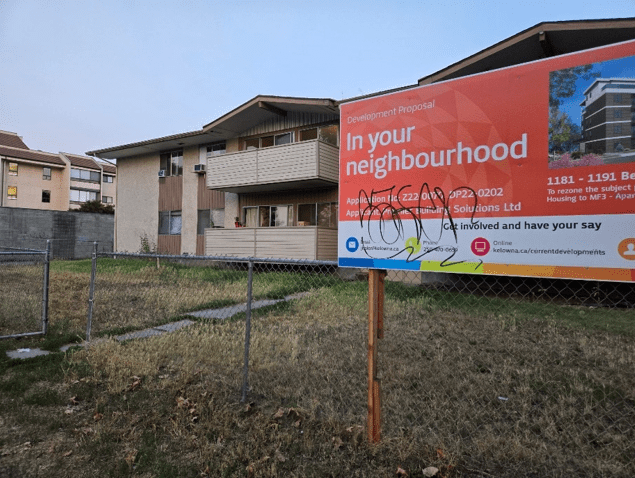
- The affordable housing with a nice green space in front is about to be torn down and replaced with another new build, driving the tenants out.
Chapter 4 2040 OCP
- Map 4.1 – Keep the existing downtown building height map
- 26 storeys in Kelowna is already too tall. The public doesn’t like these tall buildings and have been expressing that over several years. Kelowna has lost its character. The city has turned Kelowna into a tourist city and it seems at the expense of the residents. Many of the towers were built for short-term rentals and micro suites should not be allowed. A lot of the affordable motels and hotels have been torn down.The reason these towers are being built is because the developers ask. Kelowna is well known as “being open and flexible”.
- DCCs should not be the reason to allow these tall towers.
- Policy 4.4.3 – Delete
- allows taller buildings against what the height map which the public believed was what was allowed. In the 2030 OCP, 26 storeys meant 26 storeys. In the 2040 OCP, 26 storeys mean 40 storeys. Twenty six storeys should mean 26 storeys.
- Bonus heights – get rid of bonus heights – in zoning e.g., UC1
- Micro suites – get rid of micro suites
- Building Footprint – towers should be set back to allow green space to plant trees downtown – the developers can afford it
- this will allow more water infiltration (reduce runoff)
- reduce the heat island effect
- reduce the massing effect
- make the city more livable
- Encourage new lower buildings that have character
Core Area Neighbourhood
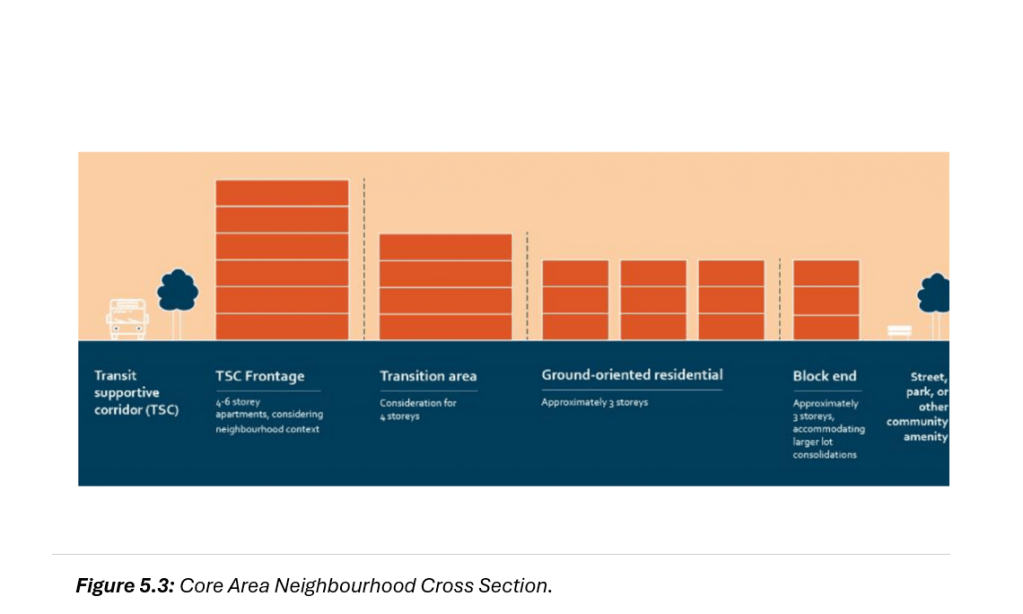
- Do not allow tall (4 or 6 storey) apartment buildings in the middle of the block – these should be located on the ends of the block in single family neighbourhoods – Right now there are front to back apartment buildings in the middle of a single-family residential area. They are massive – they block the sun, and people are now looking at tall walls right up against their property and lose their privacy – people should not be cringing when the house next door is sold.
- Follow the OCP:
“Objective 5.3. Design residential infill to be sensitive to neighbourhood context.” This is not being done.
“Policy 5.3.1. Core Area Neighbourhood Infill.
Encourage ground-oriented residential uses such as house-plexes, townhouses and narrow lot housing up to approximately 3 storeys to fit with the existing neighbourhood development pattern. Consider larger infill projects, including those where lot consolidation is required, where they are in a Transit Supportive Corridor transition area, on a block end or near community amenities including, but not limited to, parks and schools, as outlined in Figure 5.3.”
“Policy 5.3.2. Transition from Transit Supportive Corridors.
Provide a transition area allowing for 3-4 storeys in height, as outlined in Figure 5.3, serving as a transition from the medium density development along the Transit Supportive Corridors and lower density residential areas in the Core Area. Encourage ground-oriented residential such as stacked townhouses and bungalow courts with setbacks that respect adjacent lower density residential areas. Discourage commercial uses in the transition zone.”
“Policy 5.3.3. Strategic Density.
Where a proposed development in Core Area Neighbourhoods is not adjacent to a Transit Supportive Corridor, consider support for stacked rowhousing and low rise apartment and mixed use buildings, under the following circumstances:
- The property, at the time a rezoning or development permit application is made, has an area of 1 hectare or greater; and
- The project proposal illustrates that the larger buildings will be able to sensitively transition their height and massing towards adjacent Core Area Neighbourhoods, with the first priority being a transition to ground-oriented multi-unit housing within the project; and
- The project proposal includes a public park component; and
- The project proposal includes an affordable and/or rental housing component; and
- The project does not exceed a FAR of approximately 1.2 over the entire site. “
Heritage Conservation Area
The Abbott Heritage Conservation Area – it is a residential area.
- Remove it from the Core Area Neighbourhood (C-NHD) future land use designation as the land uses in the C-NHD are not permitted in the HCA. Label the Abbott and Marshall heritage conservation areas as “HCA”.
- Chapter 23, 2040 OCP – Follow:
“Justification”
“The purpose of the Heritage Conservation Area is to sustain the historical legacy of the neighbourhoods shown on Map 23.1. The special qualities of these neighbourhoods will be preserved by ensuring changes complement the established streetscape and maintain the integrity of traditional architectural forms.” This is not happening. Anything now goes in the HCAs…large new builds sided with corrugated metal and painted black. The city is not following this.
“Objectives”
- “Maintain the residential and historical character of the Marshall Street and the Abbott Street Heritage Conservation Areas;
- Encourage new development, additions and renovations to existing development which are compatible with the form and character of the existing context; (not happening)
- Ensure that change to buildings and streetscapes will be undertaken in ways which offer continuity of the ‘sense-of-place’ for neighbours, the broader community; and
- Provide historical interest for visitors through context sensitive development.”
Not happening.
“Guidelines”
“Although design freedom is encouraged, it is vital to the integrity of the Heritage Conservation Areas to have the established context serve as inspiration for new development. The dominant architectural style for the streetscape should prescribe the style of new buildings while the established patterns prescribe scale, massing and streetscape relationships. (Not occurring). Dominant patterns and key elements occurring on the streetscape of the subject site should be noted and used as the general basis for the design of a new house. The following are the landscape and architectural guidelines to be applied to all additions or new constructions within the Abbott Street and Marshall Street Heritage Conservation Areas. Applicants are encouraged to relate the guidelines to the architectural style of their property and the adjacent context. In the case of new homes, applicants are encouraged to consider the architectural style consistent with the dominant style identified for their block. However, it is not required that the architectural style of new buildings be consistent with the dominant style of the block.”
The word encourage from the above paragraph as well as the last sentence should be removed from the last paragraph as these are inconsistent with the Justification, the Objectives, and the Guidelines.
2040 OCP Figure 23.28 Follow:
“Daylighting Standards Casting of shadow on adjacent yards is minimized by stepping second storey elevations back to satisfy the sunlight requirements of the City’s Zoning Bylaw. In cases where the architectural authenticity does not accommodate a stepped building form, overshadowing may be managed through other design solutions, such as locating the building on the site in ways which satisfy the Zoning Bylaw daylighting standards.”

The Daylighting Standards are not followed such that some the new builds go from front to back leaving a long high wall for the neighbors blocking out the sun and viewscape. This has caused a lot of stress to the adjacent property owners and the people in the neighbourhood as well as visitors to the area. The guidelines in the 2040 OCP were not and are not being followed.
- Reinstate the Heritage Advisory Committee
- The city has accepted that KGH is a transit hub even though it is not one – remove the transit hub designation as KGH. The transit hub boundary includes the southern 25% of the HCA allowing 6 storey buildings in the HCA and the demolition of heritage homes and the unnecessary loss of the HCA which is less than ½ km squared.
- The HCA is on the Mill Creek Floodplain so the province exempts it from the transit hub uses anyway – this will prevent the construction of 6 storey buildings in the HCA which result in the demolition of heritage houses and the loss of the HCA unnecessarily.
 Susan Ames Sustainability Group