We need to tip the scales back to balance in Kelowna. I hope I can help by offering my ideas to the people of Kelowna and hopefully some of you will reach out to me and work with me to generate more public awareness.
Kelowna is changing rapidly. Project after project is approved but never with an environmental or social impact analysis. We are getting more roads and the city has purchased farmland for the city’s industrial uses. We don’t even have a private property tree bylaw.
Even though Mayor Dyas during his campaign for Mayor in 2022 said he would listen to the public and would have transparency at city hall, this does not seem to be the case. The city chose the Alternative Approval Process (AAP) for the largest capitiol project in the history of Kelowna over a referendum for over $240 m for a centralized community centre. This is a misue of the AAP.
The city had an opportunity early in 2024 to stop the plan to build six storey apartment buildings in the Abbott Street Heritage Conservation Area which is less than 0.5 km2 and represents less than 0.5% of the city. How? The province said such buildings were not required in transporation hub areas (TOA) which the Provincial Government mistakenly identified Kelowna General Hospital (KGH) as even though KGH only has a bus stop, if the TOA occurred on a floodplain. The Abbott Heritage Conservation Area is located on the Mill Creek Floodplain. People living in this area are not allowed to have basements or anything like a furnace or hot water tank in a crawl space because it is on the floodplain. Further, the city has a zoning bylaw pertaining to this and a corresponding map showing the Mill Creek floodplain. The city said their hands were tied yet when sent this to the Mayor and Council, as a reminder of the city’s own regulations, the Mayor and Councillors (except Councillor Ron Cannan) chose to ignore this fact and are allowing the development of apartment buildings in the Heritage Conservation Area. Why don’t they care? Why are they turning a blind eye? This is what is happening in Kelowna.
Our Concerns are many and include:
- Protection of the environment
- Housing affordability
- Planning for climate change
- Reduction in traffic congestion – we need more buses and electric buses!
- Reduction of homelessness!
Some high level ideas include:
Housing Affordability: 30% of new builds as affordable units; city to donate land for low-income housing construction; build wood buildings with affordable interior finishings; review zoning changes that are driving up housing prices.
Afforable housing such as two storey walk -ups with something like 8 or 10 units are being torn down, the renters forced out and large, market housing is being built. The developers should be required to include the 8 or 10 units of equivalent size in bedrooms and square footage, whatever is being lost, in the new build as affordable housing so people won’t be forced on the street.
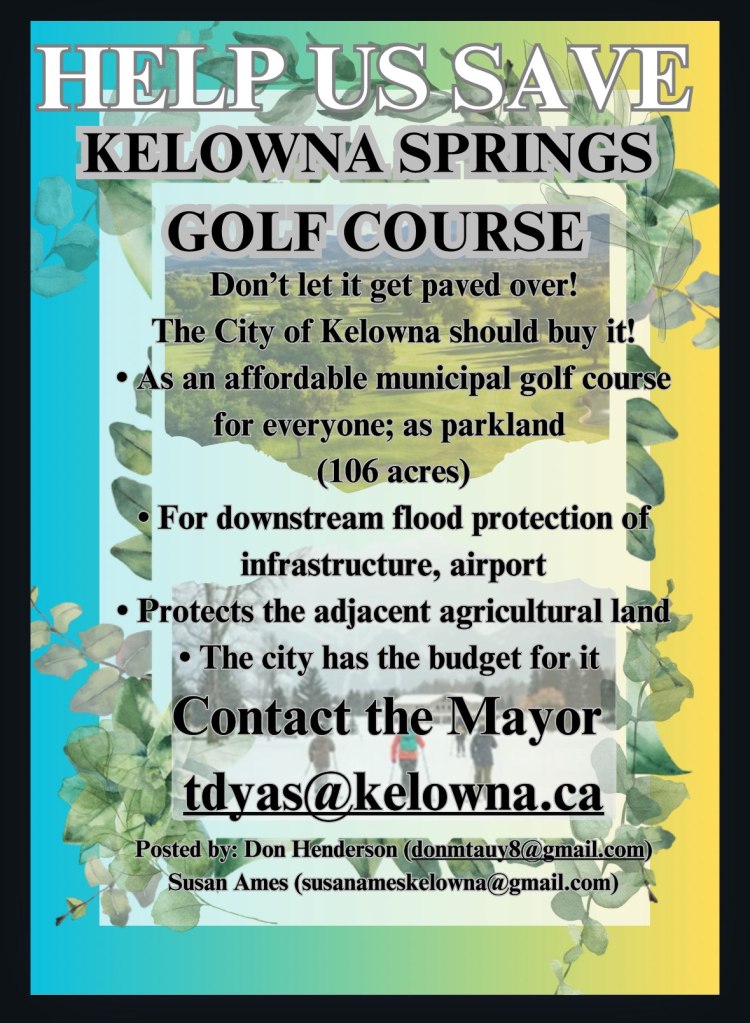
Preserve Agricultural Land/Green Space: Keep our agricultural land for current and future food production; stop the plan to build a bus barn on farmland – put the bus barn on an industrial site; stop the plan to put a sewage treatment plant on farmland; the City to purchase Kelowna Springs Golf Course for a municipal golf course and to preserve it as green space; preserve our tree canopy; require the setbacks around new builds to ensure green space/tree planting and a place for adults and children to enjoy/use; adopt a tree bylaw; rather than consider new project sites as “bare lot”, assess opportunities to retain existing trees.
Preserve our Industrial Land: Stop the conversion of industrial land to residential; keep our industry and promote more industry to provide more career jobs.
Review the Rapid Development: Stop the height and footprint variances for buildings; follow the 2040 OCP height plans; require environmental, social, infrastructure, and traffic impact assessments.
Traffic Congestion: Increase the frequency of buses and use smaller buses on quieter streets; use more roundabouts to increase traffic flow; eventually convert to electric buses and street rail transportation (similar to street cars).
Climate Change: Promote the use of solar panels, heat pumps, geothermal energy; maintain tree canopy and plant more trees; ensure all new sidewalks have a conduit below the surface for future wiring for electric car charging stations; ensure charging stations are installed in all new builds; maintain green space around buildings and large community green spaces; increase frequency of bus transportation; eventually convert buses to electric or other alternative energy; consideration in the future, the use of in-street rails for public transportation, similar to a low to the ground street car.
Transit Contract: Kelowna to take back the management of the transit drivers’ contract which is outsourced to the US and Sweden and keep the money in Kelowna and use it to support the bus drivers.
Homelessness: Provide affordable housing to be in the order of 30% of income; provide low-cost housing – for example, welfare provides $300 per month for housing so rents in that range (this would require city land as market priced land is too costly); shelters would only be used for people who do not quality for welfare due to being newcomers.
Public Input/ Public Voice: Revise the public hearing policies, e.g., note the amount of support/opposition at public hearings, keep public records available, allow the council more time to prepare for meetings/public hearings/project decisions; bring back the various volunteer committees such as the Heritage Advisory Committee and other committees such as an architectural committee; increase input from neighbourhood associations; limit the number of consecutive terms to three and return to three year terms (was changed to four year terms in 2014)
Contact Susan at: susanameskelowna@gmail.com


 Susan Ames Sustainability Group